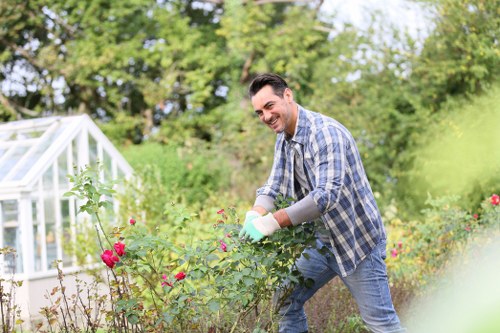
Gardening Holborn: Recycling and Sustainability
Welcome to the Gardening Holborn sustainability statement for our eco-friendly waste disposal area and sustainable rubbish gardening area. As a local gardening and green-space steward, Gardening Holborn combines practical garden management with a clear commitment to reducing waste, reusing materials and increasing recycling rates across Holborn and adjacent boroughs. Our approach to sustainable gardening in Holborn blends community partnerships, low-carbon logistics and on-site separation systems so that every green cuttings pile or soil batch can either be reused, composted or responsibly processed.Our mission sets measurable goals: we are targeting a recycling percentage target of 65% municipal and garden waste diversion by 2028, with interim milestones at 50% by 2025 and steady year-on-year improvement. This recycling and sustainability ambition for Gardening Holborn aligns with borough-level efforts to prioritise source separation and organics collection. We monitor progress through regular audits and report publicly on tonnages diverted from landfill, emphasising transparency and continual improvement.

Local transfer stations and borough waste separation
We coordinate with nearby transfer facilities and authorised waste transfer stations to ensure green waste, wood, soil and recyclable containers are routed correctly. Holborn sits at the confluence of borough systems, so we work alongside borough transfer stations and permitted facilities operated by local authorities. Many boroughs in central London operate a three- or four-stream approach — food waste caddies, garden waste bins, mixed recycling and residual waste — and Gardening Holborn mirrors this separation in the field to minimise contamination and maximise reuse.Our on-site sustainable rubbish gardening area uses clear segregation bays, labelled containers and composting bays to turn garden waste into useful outputs. Leaves, grass cuttings and prunings are diverted to our composting systems or to community compost sites; larger woody material is chipped for mulch or biomass recovery where appropriate. We emphasise soil health and the circular reuse of organic matter so that removed turf, root balls and topsoil are assessed and reconditioned rather than simply discarded.

Partnerships with local charities and community groups
Gardening Holborn collaborates with a network of charities and non-profits that specialise in reuse, redistribution and community gardening. These partnerships include working with community food projects that accept edible surplus plants or harvested produce, garden reuse charities that refurbish planters and raised beds, and local volunteer groups that run neighbourhood compost hubs. Typical partnership activities include:- Reuse of pots, soil bags and durable gardening kit through charity workshops
- Donation of surplus topsoil and compost to community allotments and food-growing charities
- Shared green waste processing events hosted with local environmental groups
These collaborations help create a resilient local supply chain for materials, support social value and reduce the carbon impact of transporting bulky garden waste out of the area.
Logistics are essential to any sustainable rubbish gardening area, so Gardening Holborn operates a fleet that is progressively switching to low-emission transport. We run a mix of electric vans, plug-in hybrids and cargo bikes for central Holborn operations to cut delivery and collection emissions in dense urban streets. By the end of 2026 we aim for at least 60% of our vehicle miles to be driven by low-carbon vans and bicycles, reducing fuel consumption and local air pollution.
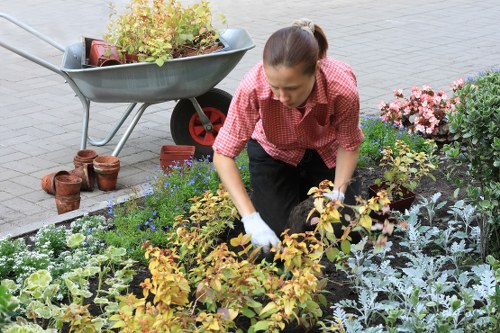 Where transfer to council-run facilities is necessary, we timetable collections to consolidate trips and use low-emission transfer routing. Our staff receive training on contamination reduction and on-site sorting so that what leaves the gardening site in a vehicle is already prepared for the next processing stage — composting, chipping, reuse or recycling — rather than being re-sorted later. This reduces double-handling and the embodied carbon of our waste management chain.
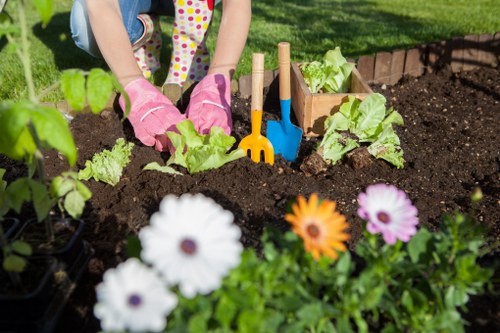 Design of the eco-friendly waste disposal area in Holborn includes secure storage for recyclable materials, covered compost bays to speed decomposition and rainwater capture for irrigation of newly planted beds. We employ signage that reflects borough guidelines on waste separation (food, garden, recycling and residual) and we supply compostable liners where councils support them. Our sustainable gardening hub acts as a local model: practical, efficient and tuned to the boroughs' approaches to source-separation and organics capture.
To support wider behaviour change, Gardening Holborn runs regular neighbourhood drop-offs for bulky green items and coordinates with community swap events so that planters, tools and timber that still have life are kept in circulation. We avoid landfill by default and prioritise reuse first, then recycling and composting; only non-recyclable residues are considered for residual disposal. This hierarchy reduces overall waste volumes and strengthens local resilience.
Monitoring and continuous improvement are central to our ambition. We measure diversion rates, contamination levels and transport emissions, and we publish targets and annual performance. Key metrics include tonnes of green waste diverted, percentage of site-generated material reused and vehicle carbon intensity. These data guide investments in equipment such as electric chippers and insulated compost bays that increase throughput while lowering environmental impact.
Gardening Holborn's recycling and sustainability commitments are practical, measurable and community-centred. By integrating an eco-friendly waste disposal area with a sustainable rubbish gardening area, low-carbon vans and strong charity partnerships, we aim to demonstrate how urban green-space management can support borough goals for waste separation and a healthier urban environment. Together with residents and local organisations, we will keep improving diversion rates and reducing our carbon footprint while nourishing Holborn's gardens and green spaces for the long term.